
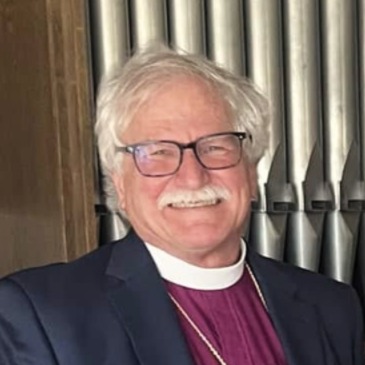
Some of you know my story. My family’s story. It is a hard story, but it is part of my DNA and it has shaped me into who I am today.
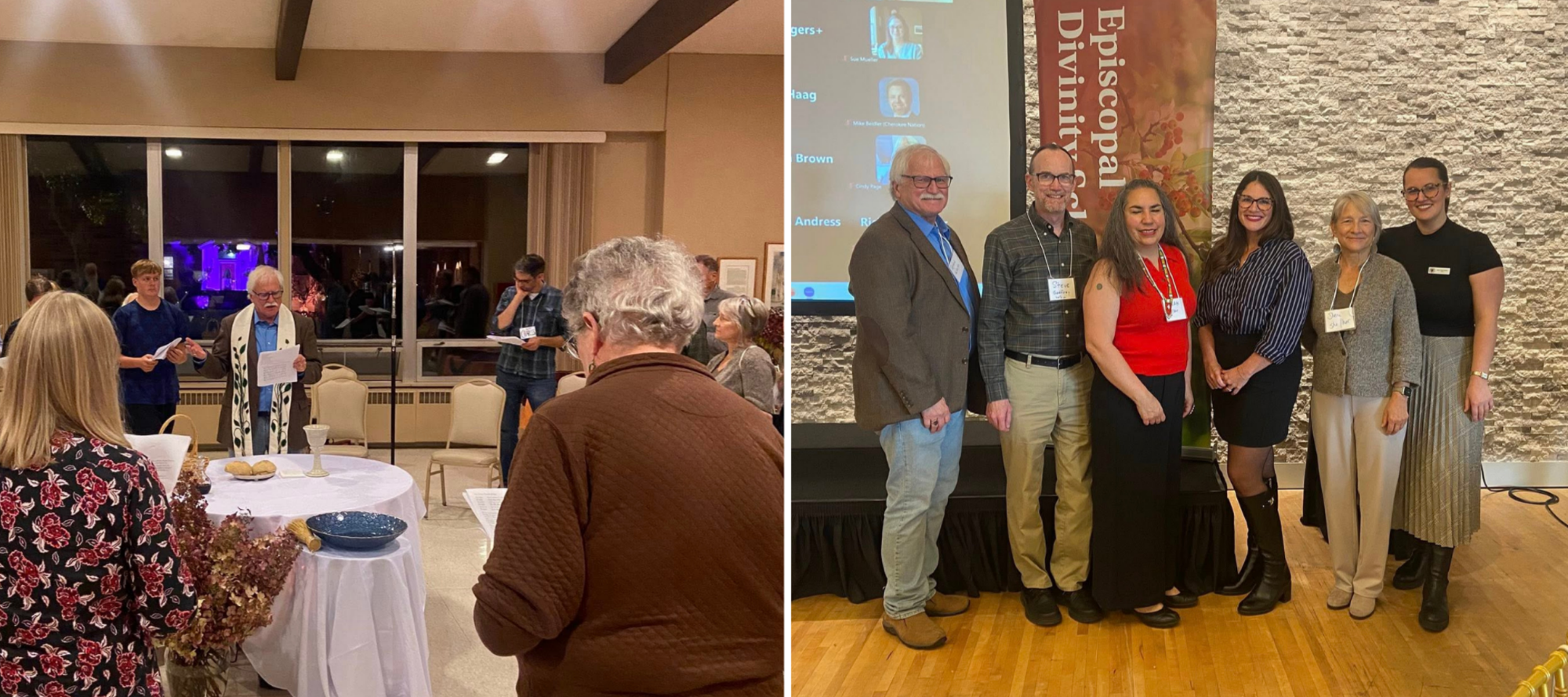 Left: Bishop Rayford Ray leads communion at the 129th Convention of the Episcopal Diocese of Northern Michigan. Right: Presenters and attendees of Hope & Healing: Engaging Indigenous Cosmologies & The Gospel In Action (left to right): Rayford Ray, Steve Godfrey (both with Diocese of Northern MI), Sarah Augustine (author), Lydia Bucklin (Dean of Episcopal Divinity School), Sheri Hostetler (author), and another individual from the Episcopal Divinity School
My mother Gertrude, who I wish you had known, was strong and courageous. She was born in 1926 in Trier, Germany to Susanna and Anton. She was one of 12 children. Most of her siblings died at birth or early childhood. My mother lived through World War II, along with her remaining family.
Her father, Anton, was known for speaking truth to power as he advocated for others. He stood with his Jewish neighbors as the Gestapo came to take them away to the concentration camp. As he advocated for them, the authorities told Anton that “he would be next if he didn't stop harassing them.”
Eventually, the Gestapo came to their home to take him to a concentration camp. But the Army intercepted him and took him to the Eastern Front-- a sure death sentence. When he arrived at the front, the commander said, “Go home! You are too weak for battle.”
In an instant, the choice made by one person, set him free and he returned home.
Two of his own children were sent to German camps for assimilation. They were released. One of those children was my mother.
Unbelievable, and yet, because of the decision of one person I am able to stand here in this time and place and share this story with you. Why I share this story is because the inhumane treatment of "others" continues to this day.
The Nazi government learned well from the US government and their treatment of and the assimilation of our indigenous siblings into a white-European culture which resulted in genocide and harm, and that trauma would be passed down from one generation to another.
The Episcopal Church was part of the assimilation and participated in the boarding school initiative as agents of the government, that harmed so many of our indigenous siblings. Both events were horrific and, in my opinion, crimes against humanity.
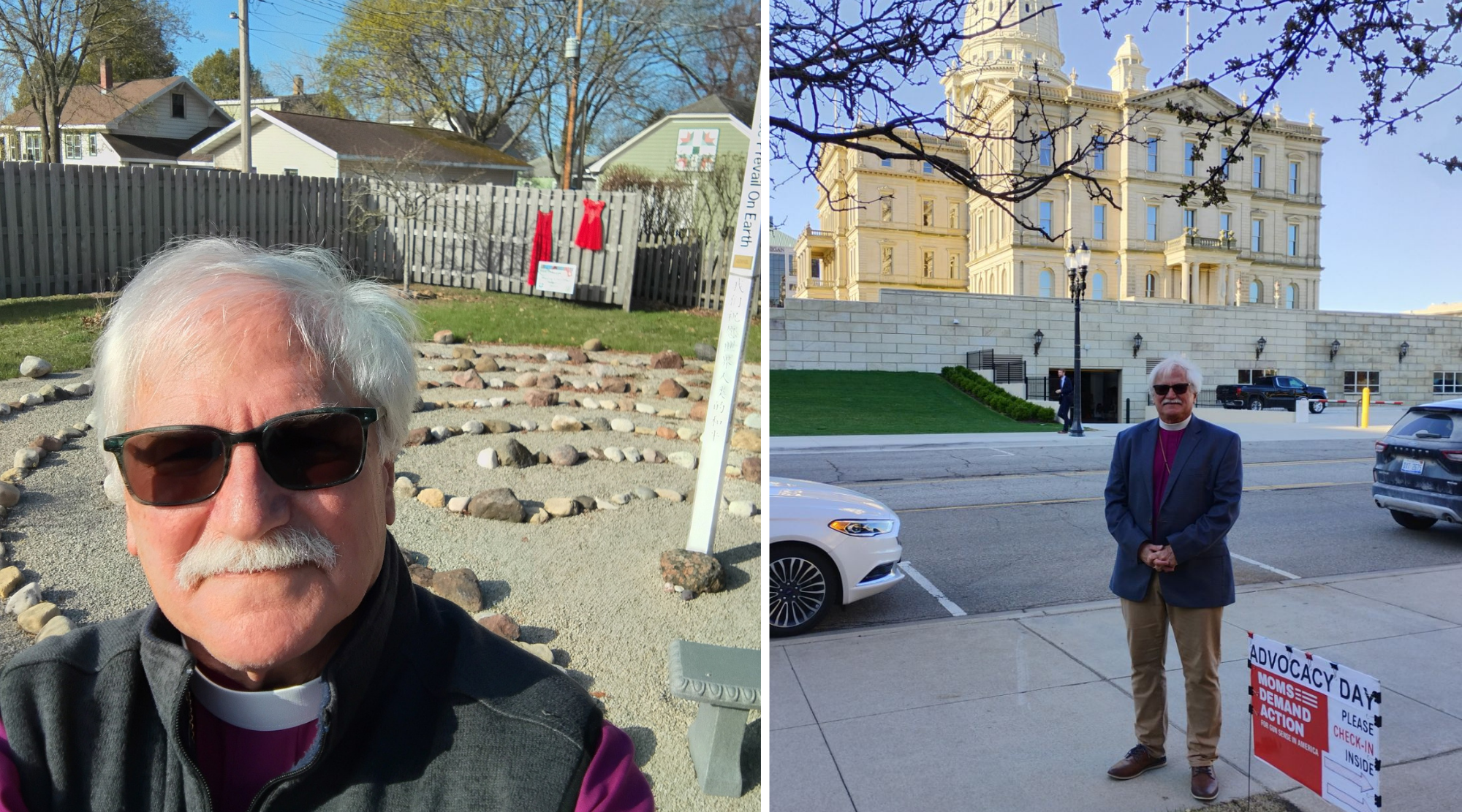 Bishop Ray in front of Trinity Church's "Peace Pole" and Labyrinth in Gladstone, MI; Bishop Ray at Michigan's State Capitol for a Moms Demand Action advocacy day against gun violence
We tell these stories not to dwell in the past, but to awaken the present.
The inhumane treatment of "othering" continues today here and now in this time. Make no mistakes about that. I see it all around me and I must say honestly, I too, have been part of this “othering” at one point or another. We still live in systems that reward silence and punish truth. That prioritize comfort over courage. That ask us to look away.
But Jesus did not look away. I believe the ministry of Jesus was a decolonizing act. Think about it, my friends, each parable, each meal, each conversation, each moment of mercy was an act of holy disruption. Each moment of mercy called this world to a new way of seeing and a new way of being.
Sarah Augustine and Sheri Hostetler (both of the Coalition to Dismantle the Doctrine of Discovery and authors of So We and Our Children May Live: Following Jesus in Confronting the Climate Crisis) invited us into this same disruption as we listened yesterday to indigenous cosmologies, or how we see the world— not as artifacts, but as living wisdom. To use scripture not as a tool of domination, but as a song of liberation. To gather together not as consumers, but as co-creators of a new way of being.
Our work, with those who have been harmed, must continue with truth-telling, with research, uncovering the past atrocities. Then, we must provide deliverables for the unjust treatment by the Church. We still have much to learn not only about healing, but how we must re-order ourselves as we walk this journey of healing, justice, and restoration. We need to be about the business of decolonizing our way of being as a Church, as we continue to learn from Jesus, and from our indigenous siblings.
Jesus loved scripture. He honored tradition. He spoke and taught in synagogues. But he did not idolize any of it. He went to the people. He went to the edges of life to the enslaved and marginalized. He was so focused on sharing the Good News, especially with those excluded from traditional spaces.
Jesus didn’t say, “I’ve come to preserve the liturgy.” He said, “I’ve come to bring good news to the poor.”
He said, “Let’s heal the brokenhearted. Let’s set the captives free.” What if we were shaped by the same urgency Jesus had? Jesus, this brown-skinned Palestinian Jew who walked this earth. What if we prioritized relationships over ceremony or ritual? Curiosity over qualifications or credentials? Equality over hierarchy? Invitation over separation? We are not called to defend tradition, but to let tradition breathe. To let it stretch and sing in new keys and let it guide us toward the margins, where Jesus always walked with others.
The Gospel is not a fortress. It is about engaging in the world. It is transformative and it is all about “love.” As simple as that and as complicated as that.
So let us pray that our worship is not only beautiful, but courageous. May our formation be not just rigorous as some would say, but relational. May our leadership be not only learned, but liberating.
May our churches be not only places to come to worship, but nurturing and sending-out places. And may we, in all things, be agents of healing. Remembering it is not by our own strength, but by the Spirit who restores all things, and calls us again and again to love the world as God, the Creator, as Jesus does. Fiercely, freely, and-- my friends-- without fear.
This is an excerpt from Bishop Ray's full address to the Diocesan convention in October 2025. You can watch the full address on YouTube.